
Rooms
Bathroom indirect lighting – IP ratings and placement
Indirect light is at its best in a bathroom: a ceiling glowing in the steam, shadow-free light at the mirror, a floating vanity. But it is a wet room, and rules are rules.

Three rules before anything else
- IP65 strip everywhere. An IP20 strip does not belong in a bathroom at all – not even on the ceiling. Moisture condenses everywhere, unless IP44-IP65 profiles are used.
- Driver outside the bathroom. In the hall, a walk-in wardrobe or on top of a cabinet outside the bathroom. The 24 V cable is brought in. Most drivers cannot take moisture and must not be in zones 0-2.
- An electrician makes the connections. A bathroom is a wet room and fixed electrical installations are always professional work. A plug-in driver is not enough, because a socket in a bathroom is in the wrong place.
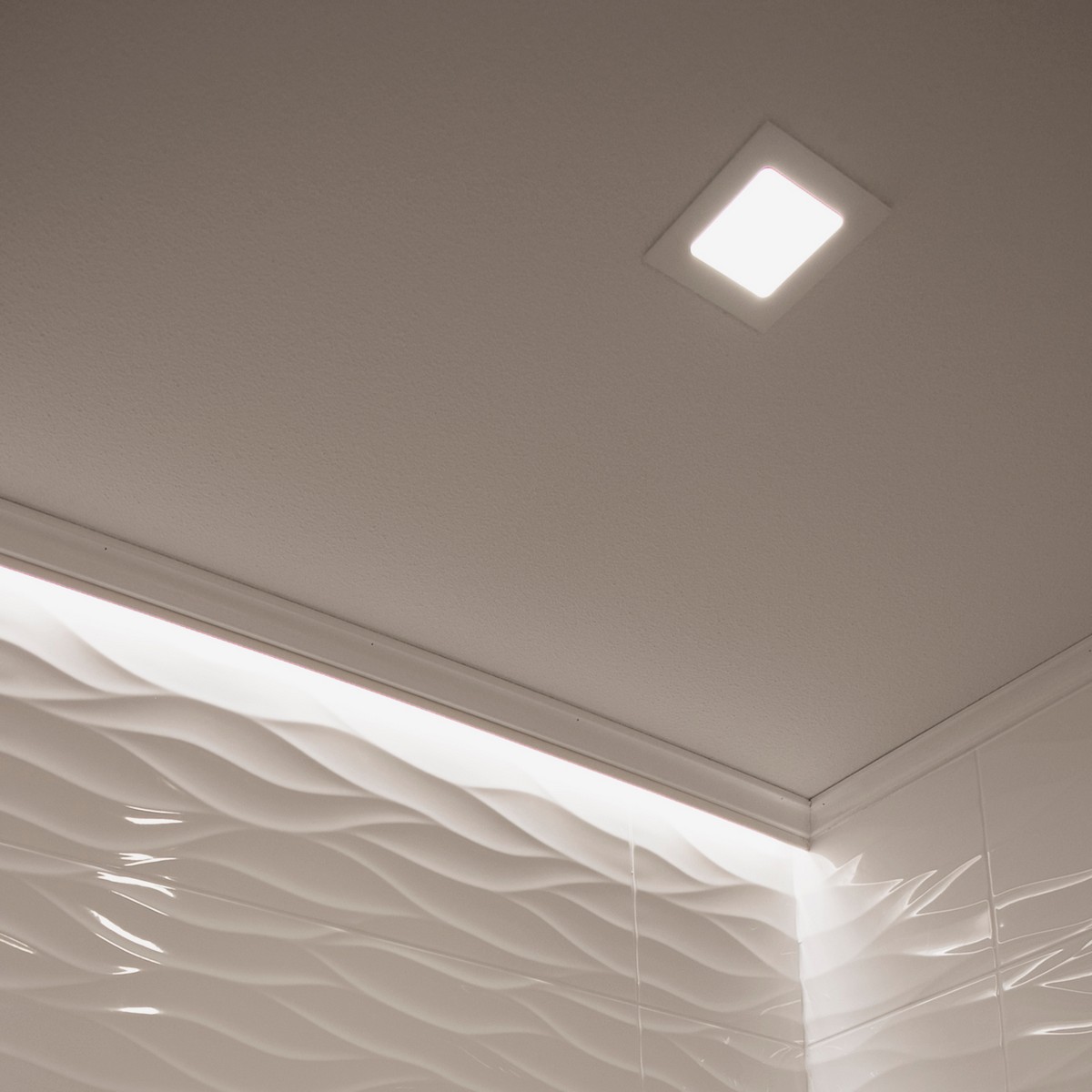
Zones 0, 1 and 2 – what they mean
Electrical safety regulations divide a bathroom into zones according to water. Bathroom lighting is designed around them, and the electrician checks them.
| Zone | Where | What may be installed |
|---|---|---|
| 0 | Inside the bathtub or shower tray | IP67 only, 12-24 V SELV. In practice no LED strip, unless the profile is also IP65. |
| 1 | Above the shower or bath up to 2.25 m height | IP65 at least, 24 V SELV. Strip in a profile OK, no joints. |
| 2 | 60 cm outward from zone 1 | IP65 recommended. Strip and joints OK, no driver. |
| Rest of the room | More than 60 cm from the shower | IP44 because of moisture. Driver still outside. |
Three places for indirect light
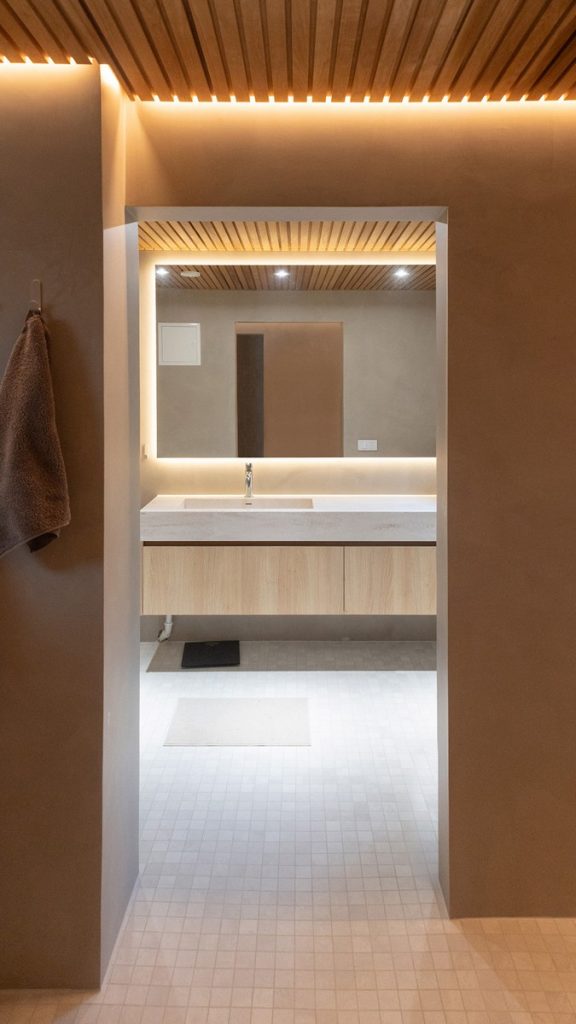
1. Around the mirror – shadow-free face light
Strip behind the mirror aimed at the wall, or vertically on both sides of the mirror. The light reaches the face from the sides and the front if the mirror has a light-transmitting opal – not from above – so there are no shadows under the eyes and chin. A reminder here, though: if the mirror is 600-800 mm across or larger, the light is far from the face and tends not to be enough without high power (+20 W/m). This is the one place in the bathroom where colour temperature matters: cool 4000 K in the morning wakes you up and shows the face accurately, 2700 K in the evening calms.
In practice: 80 cm mirror, backlight
Strip behind the mirror on all four sides, 20 mm in from the mirror edge. Perimeter 2 × (0.8 + 0.6) = 2.8 m × 14.4 W/m (actual draw 8 W/m) = 23 W. CCT strip 2700-6500 K, two-channel Zigbee driver on top of a hall cabinet. Mirror 35-45 mm off the wall so the light can get out. Driver 30 W. If the same mirror is wanted for make-up, the light output must at least double: 22-30 W/m CCT (actual draw 14-20 W/m), so a 75 W driver.
2. Vanity kickboard – night light
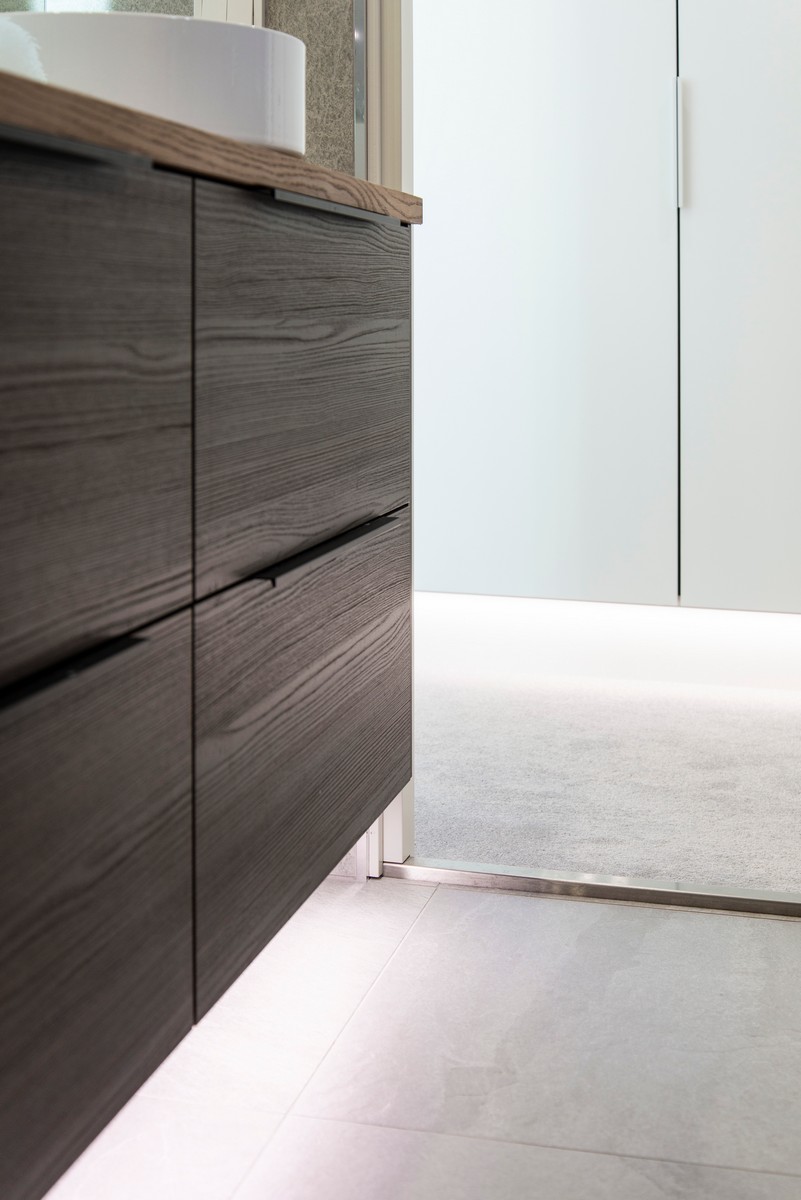
Strip behind the vanity kickboard or under the cabinet, light onto the floor. The cabinet floats and the dim floor light is enough at night – a motion sensor switches it on at 10 % and the main light is not needed. IP65, and joints inside the cabinet in the dry.
3. Edge of the dropped ceiling – soft general light
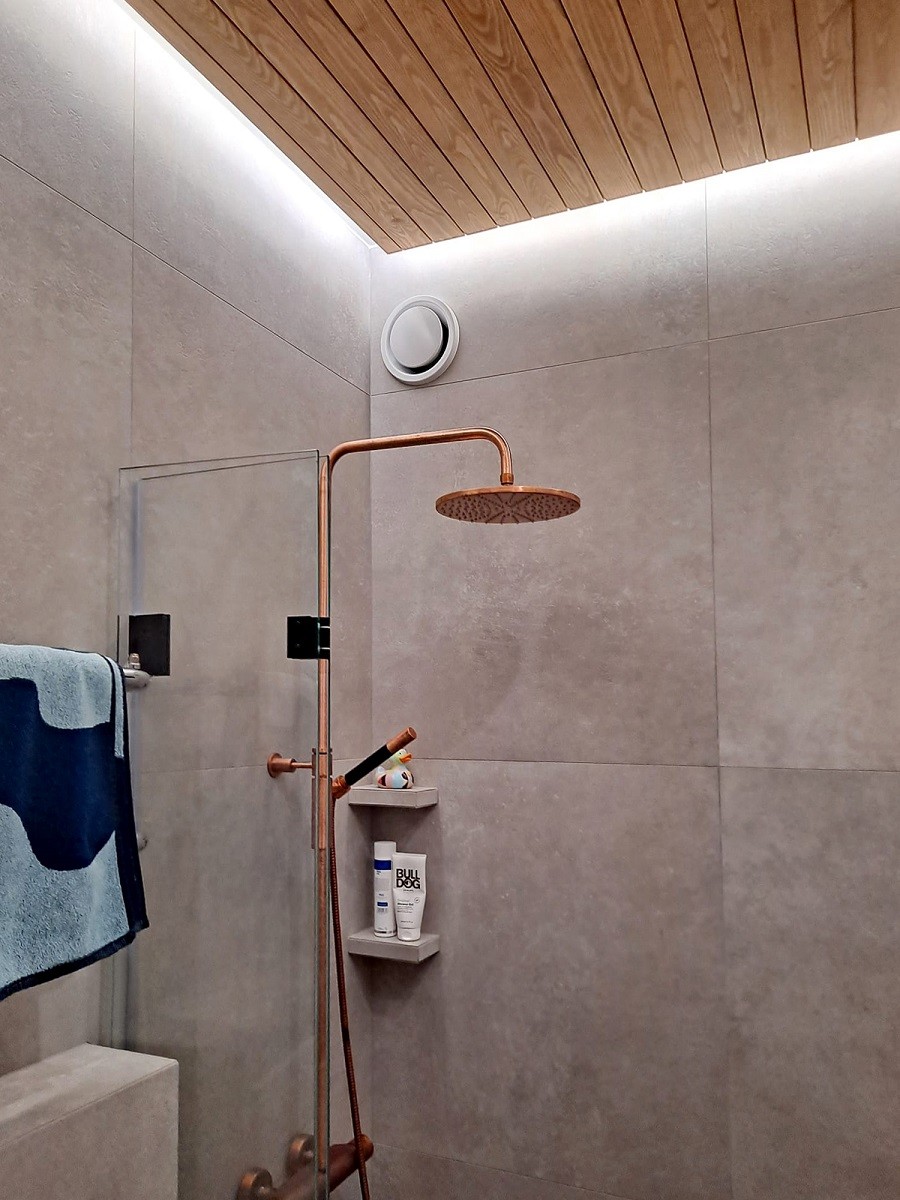
Bathrooms often have a dropped ceiling because of pipes and ventilation. An LED strip fits its edge without any extra structure: the light rises to the ceiling and the whole room glows evenly. In steam this is especially beautiful – the light is visible in the air. An access hatch in the dropped ceiling usually exists already for the ventilation.
Sizing
| Strip power | 14.4 W/m for general light and the mirror, 7.2 W/m for the kickboard |
| IP rating | IP65 everywhere in the bathroom, IP67 if the strip is in zone 1 above the shower |
| Colour temperature | CCT 2700-6500 K for the mirror, fixed 3000 K elsewhere |
| CRI | at least 95 at the mirror – skin tone and make-up |
| Joints | sleeved, no tape. Water always gets in at the end, not through the surface. |
| Driver | outside the bathroom, 24 V cable under 5 m |
The mirror cabinet’s own light is not enough
The light in a mirror cabinet’s canopy is usually a downward, spot-like light that creates shadows under the eyes. A backlight behind the mirror and vertical side light are genuinely different – faces look the way they look in daylight.
Sauna – even stricter rules → · Utility room → · Colour temperature and CCT →
IP65 strips and CCT → LedStore
Frequently asked questions
Which IP rating for a bathroom LED strip?
IP65 everywhere – moisture condenses on the ceiling too. Right next to the shower, in zone 1, IP65 and a profile are required; in zone 0 no strip at all.
How is indirect lighting done in a bathroom?
Behind the mirror, at the edge of the dropped ceiling or in the vanity kickboard. The mirror backlight is the most effective, because it lights the face without shadows – which is the whole point of mirror light.
Who may install an LED strip in a bathroom?
An electrician. A bathroom is a wet room where fixed electrical installations are always professional work. The driver is placed outside the bathroom.
Which colour temperature for a bathroom?
A CCT strip for the mirror: 4000 K in the morning, 2700 K in the evening. Fixed 3000 K elsewhere. CCT pays off precisely in a bathroom, because the same room is a workspace in the morning and a place to relax in the evening.
Can an LED strip withstand bathroom steam?
IP65 can. What matters is that the ends and joints are sealed with proper IP65 connectors – water always gets in at the end, not through the surface. No tape.
Where is the driver placed?
Outside the bathroom: on top of a hall cabinet, in a walk-in wardrobe or a technical room. The 24 V cable is taken through the wall. The driver cannot take moisture and must not be in zones 0-2.
Profiilit tähän rakenteeseen
Profiilit kipsilevykoteloon
Kaksi tapaa: matala pintaprofiili kotelon pohjaan (halvin, mutta kotelo on viimeisteltävä) tai kipsattava profiili, joka tasoitetaan yli ja muodostaa itse saumattoman valoaukon ilman näkyvää alumiinia.
Profile-INDIRECT-LOW-Z-3m
Profile-INDIRECT-curve-W-3m
profile-INDIRECT-Z-2m
Hinnat sisältävät ALV 25,5 % ja ovat LedStore.fi:n voimassa olevia hintoja. Profiilit sisältävät opaalikannen ja päätypalat; LED-nauha tilataan erikseen.
Toteutettuja kohteita
Epäsuora valo kylpyhuoneessa
Katon reuna, suihkusyvennys ja peilialue – IP44-toteutuksia kosteissa tiloissa.
Kuvat: LedStore.fi toteutetuista kohteista.