
For professionals
Indirect lighting for contractors
Indirect lighting is a building detail, not a luminaire. It is built by four trades, and the wrong sequence means demolition. Here is the work sequence, contract boundaries and check points.

Why this differs from a normal luminaire installation
A normal luminaire is hung when the ceiling is finished. Indirect lighting is inside the structure: the profile in the battens, the driver behind an access hatch, the strip in a box whose edge is the glare shield. If the box is boarded before the profile is in place, it is opened up. If there is no hatch for the driver, the ceiling is opened five years later.
That is why the contractor’s most important task is not installing but coordinating the work sequence between the carpenter, plasterboarder, painter and electrician.
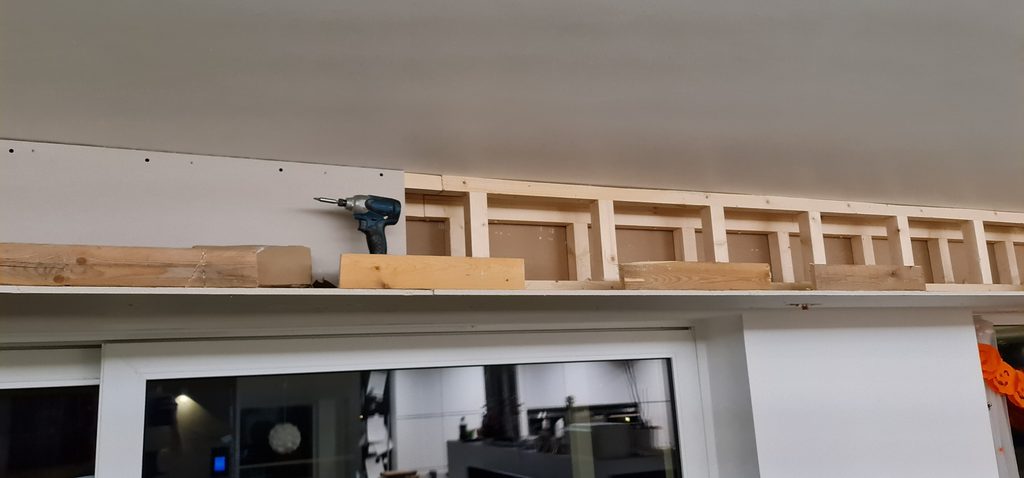
Work sequence – six stages and who does what
| Stage | Who | What | Check before the next |
|---|---|---|---|
| 1. Setting out | Carpenter | Box line with a laser, room height at several points | Line straight ±2 mm / 3 m |
| 2. Battens | Carpenter | 48 × 48 or metal studs at 40 cm centres, separate stud for the lip | Depth and lip height as per the plan |
| 3. Electrics | Electrician | 230 V to drivers, 24 V to the strip, control cables if wired | Cables at the access hatch, not boarded in |
| 4. Profile + test | Carpenter / electrician | Plaster-in profile into the battens. Test the cable if it was not run in conduit. | Strip not visible from the sofa Cable can still be replaced! |
| 5. Boarding + skimming | Plasterboarder | 13 mm board, access hatch frame, jointing, sanding | Box edge straight – light reveals any wave |
| 6. Painting + connection | Painter / electrician | Matt paint inside the box too. Strip, driver, test. | Works before the hatch is closed |
In practice: a 40 m² living room, light cove on the long wall, 7.5 m
Carpenter 2 days (battens + profile), electrician 3 h over two visits (cables at stage 3, connection at stage 6), plasterboarder 1 day, painter 1 day. 4.5 working days in total + drying times.
The critical point: the electrician’s first visit is BEFORE boarding – if they only come at the end, the cables are run on the surface or the board is opened.
Contract boundaries – three things that fall between trades
These do not clearly belong to anyone, so they are left undone. Agree them in writing before starting.
- Access hatch. The electrical designer places the driver in the box, but the hatch is a building detail. Record: the plasterboarder builds a hatch of at least 300 × 300 mm at the driver, position on the electrical drawing.
- Profile installation. A plaster-in profile is a structural part and goes into the battens – carpenter’s work. A surface profile goes on a painted surface – electrician’s or lighting installer’s work. Same product, different contract.
The most common mistake on site
The electrician is booked for one visit at the end. Then the cables are not in the battens, the driver position has been boarded over, and the only options are surface wiring or opening the board. Two visits – before and after boarding – are cheaper than one demolition.
Dimensions that must be on the drawing
| Box depth | 50-150 mm depending on the structure, 61 mm with 48 × 48 battens |
| Light slot width | 30-50 mm |
| Lip height | 30-50 mm with the strip at the back of the box, 15-25 mm with the strip behind the lip |
| Strip distance from back wall | ≥ 40 mm |
| Access hatch | ≥ 300 × 300 mm at the driver |
| Minimum batten depth for a low Z profile | 17 mm, battens 14.5 mm off the finished surface |
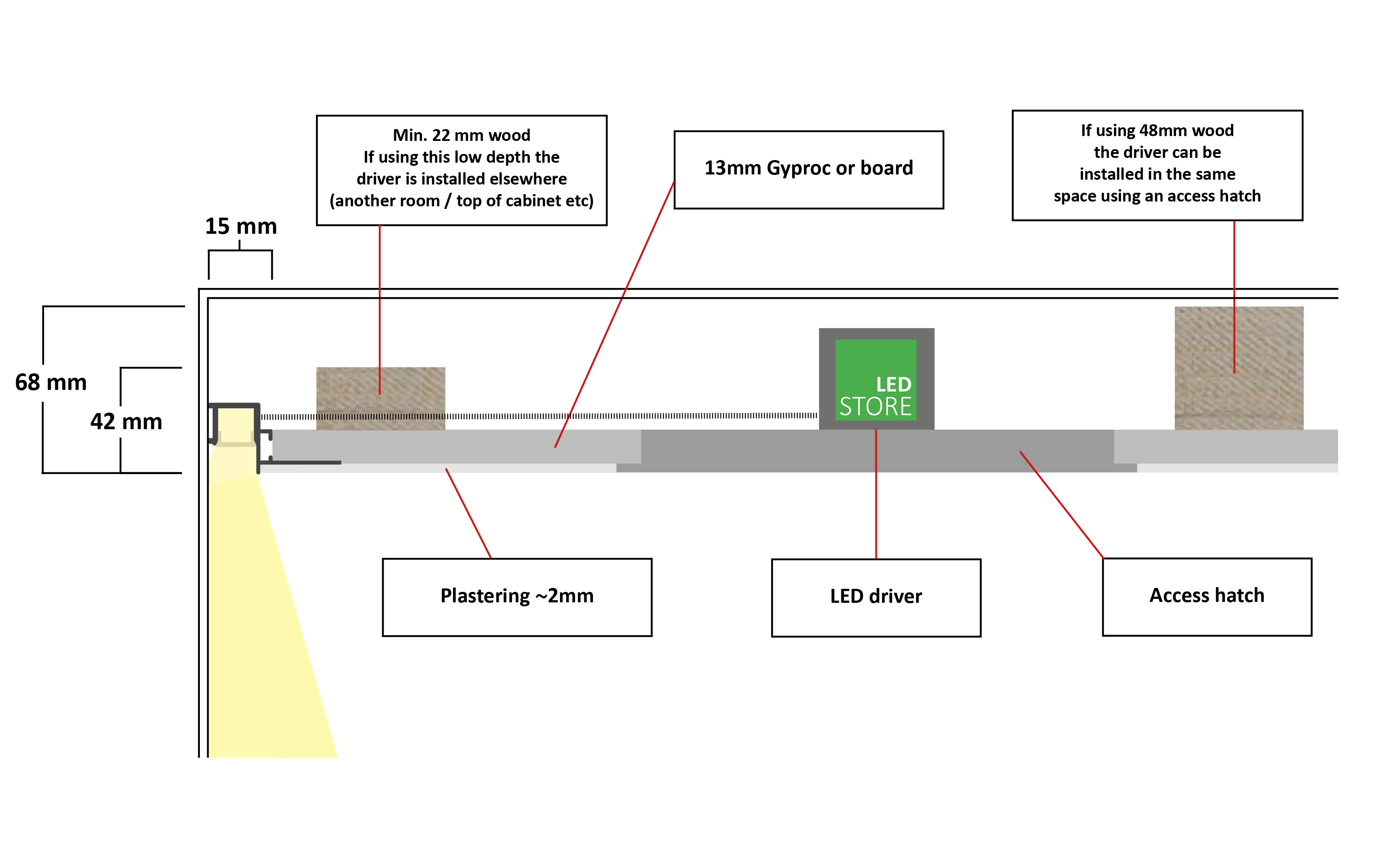
All cross-sections with dimensions: Construction drawings · Plasterboard box step by step · Glare shield
Made to measure – less work and waste
LedStore cuts profiles and strips to the project’s dimensions and seals the ends. Ready parts arrive on site: no sawing, no soldering, no offcuts. Take the dimensions from the plan when the battens are finished, order, and the parts arrive within a week. Corner connectors and end caps in particular are worth ordering at the same time – they are the parts that are missing when the strip is being installed.
Contractor services → LedStore
Frequently asked questions
What does a contractor need to know about indirect lighting?
Three things decide it: batten depth, profile installation sequence and cable routes. The profile is installed before boarding, the electrician visits twice, and the glare test is done while the board is still open.
At what stage is the profile installed?
A plaster-in profile goes into the battens before boarding – it is a structural part and carpenter’s work. A surface profile goes on last on a painted surface – that is installation work. Same product group, different contract.
How deep must the battens be for indirect light?
Traditional 48 × 48 mm is enough for most structures, a 61 mm box with the board. In the lowest solutions the minimum batten depth is 17 mm and the battens are kept 14.5 mm off the finished surface.
Who is responsible for the electrical work?
A fixed connection to the mains is always electrician’s work. Mechanical installation of the strip and profile is building work. The interface should be agreed in writing – especially who installs the surface profile.
When is the electrician booked?
For two visits: the first before boarding for cables and the driver position, the second at the end for connection. One visit at the end means surface wiring or opening the board.
Who does the glare test?
It has to be agreed – usually the carpenter or electrician at stage 4 when the strip is temporarily connected. Without a named person responsible, the test is skipped and the lip stays too low.