
Design
Glare shield sizing
The strip must not be visible – the whole of indirect lighting depends on it. The lip that hides it is sized by calculation, but checked by sitting on the sofa before the board goes up.

What a glare shield is and why it fails
The glare shield is the front edge of the bulkhead – the lip between the strip and the viewer. When it is the right height, you see only the lit ceiling. When it is too low, you see the strip: a bright line or a row of dots that draws the eye and makes the whole lighting look cheap.
Why does it fail so often? Because it is sized standing up. The builder stands in the room, looks at the ceiling, the strip is hidden – fine. Then people move in, sit on the sofa, and the strip shows. Seated, the eye is 40-50 cm lower and the viewing angle to the ceiling is shallower. From the sofa you can see behind the lip.
Sizing rule
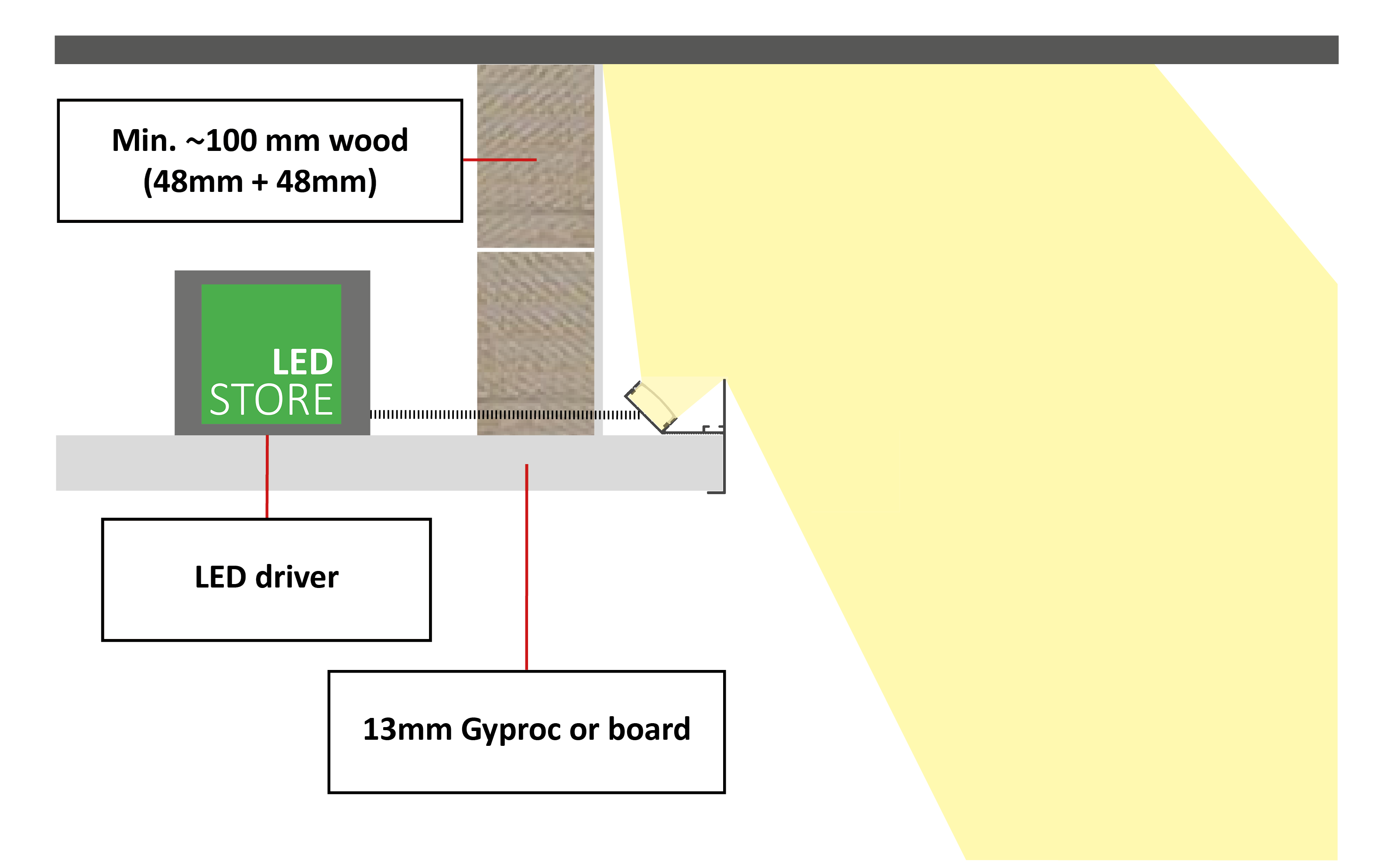
The lip height does not depend on the bulkhead height but on how far the strip is from the lip and the viewing angle: 30-50 mm with the strip 40-60 mm back from the lip, 15-25 mm with the strip right behind the lip. The figures assume a viewer 2-4 metres away with the eye at 1.1-1.7 metres.
| Bulkhead height H | measured from the floor to the top of the bulkhead – not the bulkhead’s own height |
| Glare shield | strip 40-60 mm back: 30-50 mm · strip right behind the lip: 15-25 mm |
| Strip distance from back wall | at least 40 mm – the light needs room to spread before the ceiling |
| Opening width | at least 1.5 × the strip’s distance from the back wall – narrower restricts the beam |
| Strip direction | upwards or 45° towards the ceiling – never towards the viewer |
In practice: living room, ceiling height 2.5 m, sofa 3 m from the wall
Bulkhead at the wall-ceiling junction 120 mm high, strip 50 mm from the back wall. Seated, the eye is at 1.15 m. Line of sight from the eye to the top of the bulkhead: a rise of 2.5 − 1.15 = 1.35 m over 3 m, i.e. an angle of about 24°. The lip has to hide the strip from this angle: 50 mm × tan(24°) ≈ 22 mm, plus a 15 mm safety margin → lip 40 mm. If the sofa is 2 m away, the angle is 34° and the lip 50 mm.
The closer the sofa, the higher the lip
The calculation gives a direction, but what decides is the closest viewing position. A corner sofa next to the wall looks at the lip almost from directly below – then the lip is 60-80 mm, or the strip is moved to another wall.
This whole calculation is turned on its head the moment you accept that the light will be cut, by mounting the LED profile directly behind the lip. Then the lip height can be halved. In practice, a 30 mm lip in front of a 10 mm high LED profile already works when the profile is fixed right against the lip.
Two tests before plasterboarding
No calculation knows where the furniture will be. When the bulkhead is framed but the plasterboard is not yet fixed, do these two things – raising the lip then takes ten minutes, after plasterboarding it means demolition.
- Seated test. Put a chair or stool where the sofa will go. Sit and look at the ceiling towards the bulkhead. Tape the LED strip temporarily in place and switch it on – can you see the strip or a bright edge? If you can, raise the lip or move the strip back.
- Lying-down test in the bedroom. Lie where the bed will be and look at the ceiling. Lying down, the viewing angle is almost vertical, and a ceiling-line bulkhead on the bed side is almost always visible – that is why in the bedroom the strip is left out above the bed or placed behind the headboard.
Three other sources of glare
- Glossy ceiling. Gloss or semi-gloss paint reflects the strip as a mirror image even if the lip is right. Paint the ceiling matt or fully flat, even though it slightly reduces the light entering the room (in theory a reflectance of 1.0 → 0.8).
- Strip too close to the ceiling. If the strip is less than 30 mm from the ceiling, a bright sharp stripe forms on the ceiling that dazzles even though the strip is hidden. 40-60 mm is the right distance.
- Window and mirror reflections. A window or mirror opposite shows the inside of the bulkhead from an angle the lip does not cover. Check at night against the window.
Light cove – structure and dimensions → · Plasterboard bulkhead → · Design guide →
Profiles with a built-in glare shield → LedStore
Frequently asked questions
How high should the glare shield be?
It depends on the strip’s distance from the lip: 30-50 mm with the strip 40-60 mm back, 15-25 mm with the strip right behind the lip. What decides is the closest seat – next to a corner sofa the lip may need to be 60-80 mm.
Is the LED strip visible in a light cove?
Not if the lip is high enough and tested seated. The most common mistake is sizing it standing – seated, the eye is half a metre lower and sees behind the lip.
How is glare prevented in indirect lighting?
Three things together: the strip hidden behind the lip, the strip aimed upwards rather than at the viewer, and a matt ceiling that does not reflect the strip as a mirror image.
Why does indirect light cause glare even though the strip is hidden?
A glossy ceiling reflects the strip. Or the strip is too close to the ceiling and makes a bright stripe. Or a window opposite shows the inside of the bulkhead. Use matt paint and keep the strip 40-60 mm from the ceiling.
When is the glare shield checked?
When the bulkhead is framed but the board is not fixed. Raising it then takes ten minutes. After plasterboarding and painting it means demolition.
Does a surface profile need a glare shield?
In corner profiles and indirect-light surface profiles the shield is built into the profile’s shape. A standard U-profile has none – it does not suit the wall-ceiling junction without a separate lip.