
Products
LED strip for indirect lighting
Indirect light loses about 75 % of its output to the ceiling – which is why the strip differs from one for direct lighting. Five decisions: technology, power, voltage, colour rendering and width.

Why indirect light needs a different strip
When a strip lights a worktop directly, all the light goes there. When it lights the ceiling, the ceiling reflects 80 % if white and 40 % if wood – the rest is absorbed. After that the light spreads through the whole room, not onto one spot. In practice indirect general lighting needs about double the power of direct: 14.4 W/m where direct light would manage with 7.2 W/m.
The second difference is visibility. In direct light the strip is often behind a diffuser or far away. In indirect light a low profile brings the strip close to the diffuser or the ceiling, and the LED dots show on the ceiling as a row unless the strip is dotless.
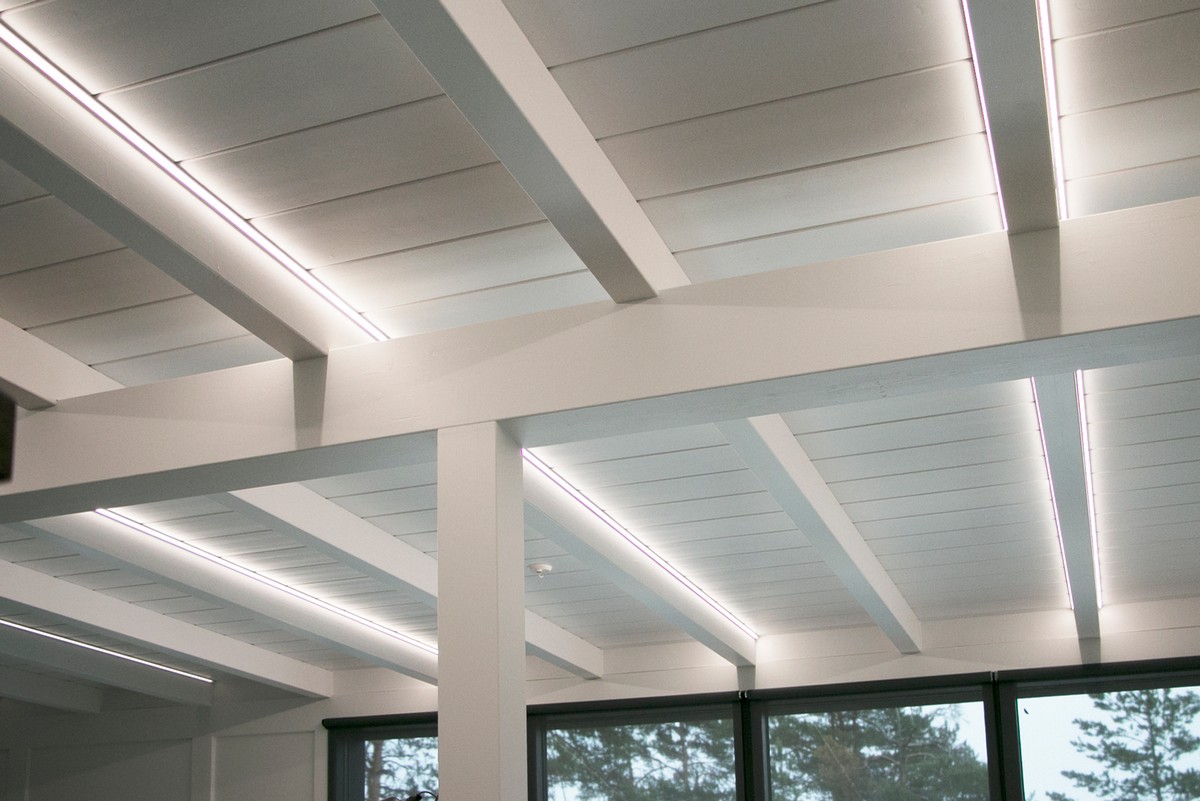
Decision 1: COB or SMD
An SMD strip has separate LED chips every 5-15 mm. In a COB strip the chips are covered with a continuous phosphor layer, and the light surface is a continuous line. The difference shows when the strip is close to the surface:
| COB | SMD | |
|---|---|---|
| Light surface | Continuous line, no dots | Row of dots, blends with distance |
| In a profile under 20 mm | The only one that works | Dots show on the ceiling |
| In a bulkhead over 20 mm | Works | Works, dense 120-240 LED/m |
| Price | About 30 % more expensive | Cheaper |
| Luminous efficacy | Slightly lower lm/W | Better lm/W |
| Suits | Surface profiles, low bulkheads, furniture | Light cove, dropped ceiling, deep bulkheads |
The deciding dimension is the profile depth from the strip to the diffuser or reflecting surface – not the size of the bulkhead. COB vs SMD in depth →
Decision 2: Power W/m
| Use | Power | Examples |
|---|---|---|
| Mood lighting | 3.6-7.2 W/m | Sauna, kickboard, stairs, furniture, bedroom in the evening |
| General lighting, light ceiling | 14.4 W/m | Living room, bedroom, hallway, bathroom |
| General lighting, wood panelling or high room | 17 W/m | Log house, ceiling height over 3 m, office |
| Task lighting (direct) | 17 W/m | Kitchen backsplash, utility room worktop |
In practice: living room 25 m², white ceiling, 15 m of strip
14.4 W/m × 15 m = 216 W. Luminous flux about 1 400 lm/m × 15 = 21 000 lm, of which the ceiling reflects 80 % = 16 800 lm into the room. Over 25 m² that is about 180 lx on average, i.e. living-room light.
The same room with a pine-panelled ceiling: 17 W/m and 50 % reflectance → 12 750 lm → 130 lx. With a dark ceiling: indirect general lighting is not enough unless the amount of light is also increased. It may be easier to fit just 7.2 W/m as mood lighting and add spotlights in the ceiling.
Decision 3: 24 V
Always 24 V. In a 12 V strip voltage drop is four times as large, and the far end dims after just 3-4 metres. At 24 V a single run can be 7-8 metres from one end, and longer when fed from both ends. 12 V is only justified in solar panel systems.
Decision 4: CRI at least 95
Colour rendering index. In indirect light it matters more than in direct light, because the light reflects off a surface and the colour error compounds. CRI 80 makes skin grey and wood flat. LedStore’s strips have a CRI of 95-97. Colour temperature and CRI →
Decision 5: Width and the profile groove
Strip widths are 5, 8 or 12 mm. Profile grooves are 6, 9 or 12 mm. A 10 mm strip does not fit a 7 × 18 mm surface profile. Choose the profile first, then the strip – or order both made to measure from the same place, so compatibility is guaranteed.
Cut interval
A strip can only be cut at marked points, typically every 5 or 10 cm. On a 3.72 metre wall you end up 2-8 cm short. LedStore’s ”cut anywhere” strip has a cut point every centimetre – the length is exact and no dark gap is left in the corner, but the strip also has a downside due to its construction: its efficiency is poor. Only 700 lm from a 14.4 W strip (compared with 1 300 lm from standard ones!)
Which strip for which room
| Room | Strip | Why |
|---|---|---|
| Living room, light cove | SMD 14.4 W/m CRI 95, or COB | Deep bulkhead, SMD is enough, cheaper |
| Retrofit with a surface profile | COB 14.4 W/m | Low profile, SMD would show dots |
| Bedroom | COB 7.2-14.4 W/m 2700 K or CCT | Dimmable, warm |
| Kitchen backsplash | SMD 17 W/m CRI 95, IP65 near the sink | Direct task light, true colours |
| Bathroom | COB 14.4 W/m IP65, CCT at the mirror | Moisture, tone morning/evening |
| Sauna | COB 3.6 W/m IP65 | Heat, only under the benches |
| Kickboard, stairs | COB 7.2 W/m IP65 | A glossy floor reveals the dots, gets washed |
| Furniture, display cabinet | COB 5 mm 7.2 W/m CRI 97 | Viewed up close, narrow profile |
Aluminium profiles → · Driver sizing → · How much light by room →
LED strips → LedStore
Frequently asked questions
Which LED strip for indirect lighting?
For general lighting 14.4 W/m and CRI 95, 24 V. COB for a profile under 20 mm, SMD is fine in deeper ones. 7.2 W/m for mood lighting, 3.6 W/m IP65 for the sauna.
How many watts per metre are enough?
Indirect light loses about 75 % to the ceiling, so the power is double that of direct light. General lighting on a light ceiling 14.4 W/m, on wood panelling 17 W/m, mood 7.2 W/m.
12V or 24V LED strip?
24 V always. Voltage drop is a quarter, and a run can be 7-8 m from one end. 12 V only in solar panel systems.
Does an LED strip withstand damp rooms?
IP65 withstands splashes and steam. Always IP65 for the bathroom, sauna and splash zones. IP20 does not belong in a wet room at all.
Can an LED strip be cut?
At marked points, every 5-10 cm. The length will not always be exact. A cut-anywhere strip has a cut point every centimetre.
Does an LED strip need an aluminium profile?
A strip over 10 W/m needs one for cooling – without a profile the light output drops and lifetime shortens. A profile also gives a straight line and a glare shield.