
Public spaces
Retail indirect lighting
In a shop, light is part of the fixtures. Shelves, display cases, kickboards and counter edges – indirect and direct light in the same structure, with soft general light from the ceiling on top.

Fixture lighting is the core of a shop
At home indirect light comes from the ceiling. In a shop it comes primarily from the fixtures: from the shelf edge, inside the display case, from the kickboard and under the counter. General light from the ceiling is the background; fixture light is what sells. This is the most common solution from clothing stores to pharmacies, and it is done with LED strip in a profile – the same technique as indirect light at home.
The difference is that in fixtures indirect and direct light run side by side. A strip at the front edge of a shelf lights the products below directly, and a strip at the back edge of the same shelf rises indirectly to the back wall. Both are in the same fixture, often in the same profile.
Four fixture solutions
1. Shelf front edge – direct light on products
Strip under the front edge of the shelf, aimed downward. Lights the products on the shelf below directly and evenly. The most common fixture light: clothing store shelves, pharmacy shelves, grocery display cases. A recessed shelf profile needs a groove of about 12 mm; a 16 mm board is enough.
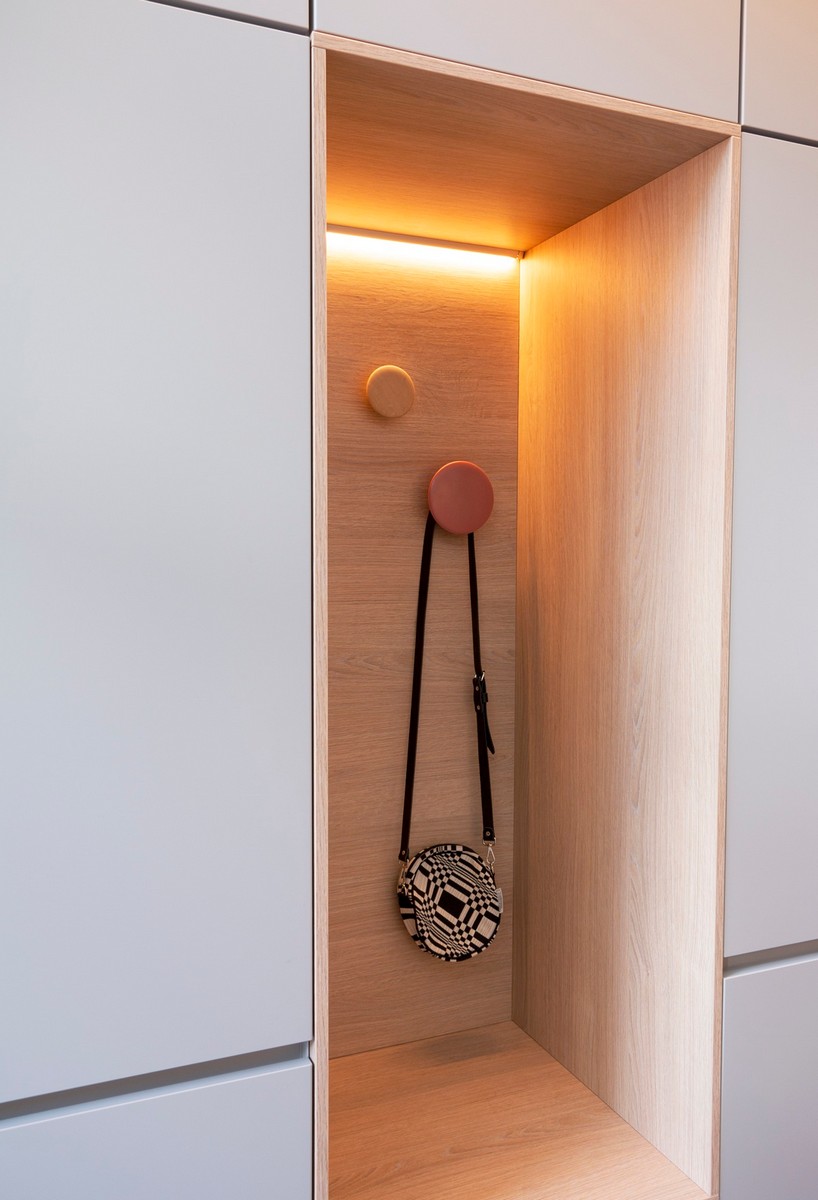
- Strip: 7.2-14.4 W/m, CRI 95-97. Dot-free COB, because the viewer is close.
- Profile: recessed shelf profile, or clip-on edge profile for boards up to 17.5 mm.
- Colour temperature: by product – clothing 3000 K, electronics 4000 K, food 2700-3000 K.
2. Shelf back edge – indirect light to the back
Strip at the back edge of the shelf aimed up or at the back wall. The light washes the back of the fixture and lifts the products off it. This is what makes a shelf ’lit’ rather than just ’light on a shelf’. Together with the front edge it creates a layered effect where the product is brightest and the background glows.
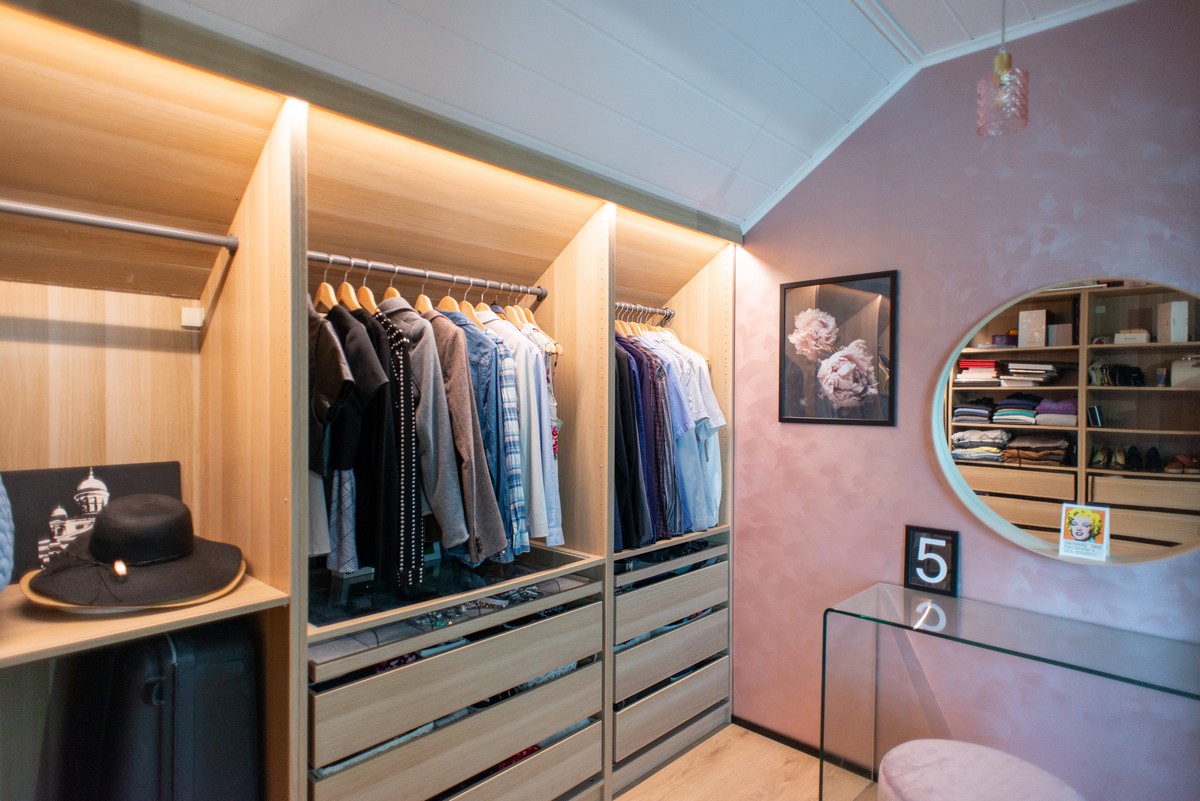
- Strip: 7.2 W/m is enough – the background must not compete with the product.
- Profile: 45° corner profile or low surface profile in the inside corner of the fixture.
- Rule: backlight at most one third of the product light intensity.
3. Kickboard and underside of the counter – floating fixture
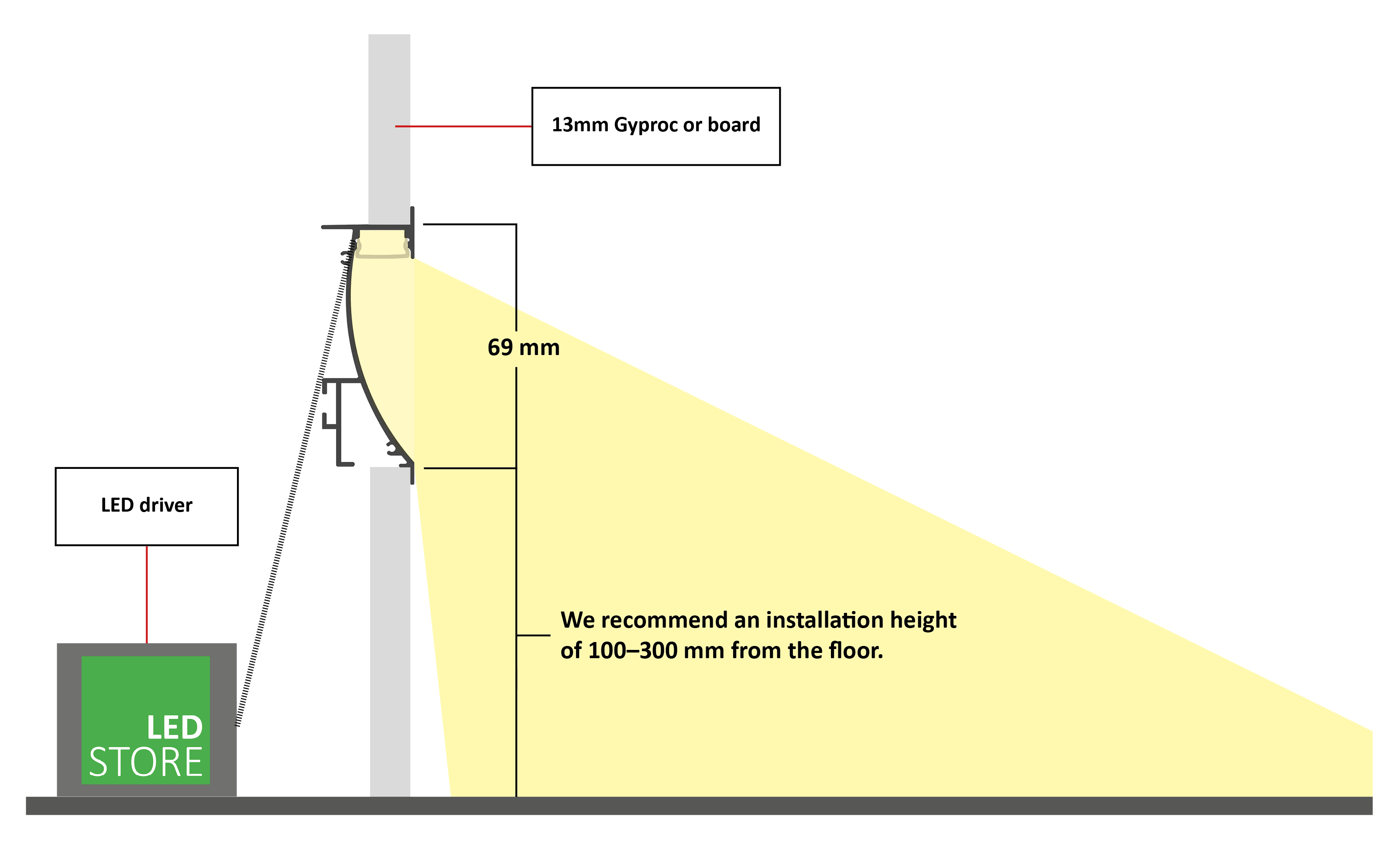
Strip behind the fixture’s kickboard or under the counter, aimed at the floor. The fixture seems to lift off the floor. It guides customer flow, highlights the checkout and service counter, and works as a night light when the shop is closed – seen from the shop window.
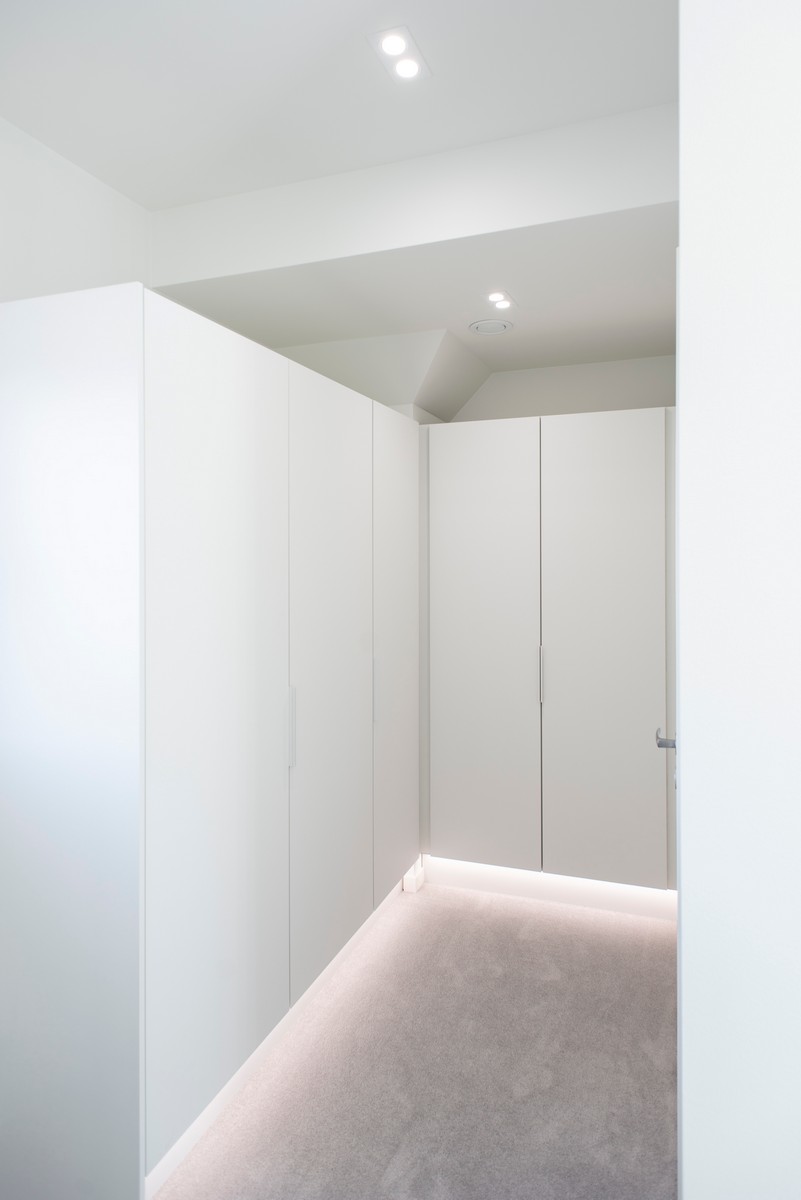
- Strip: 7.2 W/m, IP65 if the floor is machine-washed.
- Profile: surface profile on the inside of the kickboard, light down.
- Note: a glossy floor reveals dots – COB or enough distance.
4. Display case – light from inside
A closed glass fixture where the strip runs along the inside of the top edge or in the vertical corners. In a display case colour rendering is decisive: below CRI 95 makes jewellery look grey and cosmetics flat. A narrow 5 mm strip fits the thinnest profiles, and heat must be managed – a closed space heats up.
- Strip: 7.2-14.4 W/m, CRI 96-97, COB.
- Profile: recessed 45° SLIM or narrow surface profile.
- Heat: aluminium profile essential, and an air gap in a closed display case.
5. Kickboard lighting guides the customer
Furniture – profiles and dimensions → · Kickboards →
General light from the ceiling – the background for fixture light
Once the fixtures are lit, the ceiling’s general light keeps the surroundings pleasant without competing with the products. Indirect light from a dropped ceiling or light cove gives 300-500 lux without glare. Track spotlights raise selected products to 750-1000 lux.
| Light level | Intensity | Source | Job |
|---|---|---|---|
| General light | 300-500 lx | Indirect from the ceiling | Pleasant background, no glare |
| Fixture light | 500-1000 lx on product | LED strip in the fixture | Products stand out, shelf takes shape |
| Accent light | 750-1500 lx | Track luminaires | Selected products take centre stage |
| Kickboard and mood | 20-50 lx on the floor | LED strip in the kickboard | Circulation, floating effect, night light |
Contrast is a sales tool
Light that is too even makes a shop flat – everything looks equally important, i.e. nothing does. A 1:3 ratio of general light to product light guides the eye. This is why fixture light is done separately instead of raising the general light.
Recommendations by sector
| Sector | Colour temperature | CRI | Emphasis |
|---|---|---|---|
| Clothing and interiors | 3000 K | 95-97 | Backlight and shelf front edge – material and colour |
| Electronics | 4000 K | 90+ | Direct shelf light – the product looks technically precise |
| Food and natural products | 2700-3000 K | 95+ | Display case and kickboard – appeal |
| Jewellery, cosmetics, optics | 3000-3500 K | 96-97 | Display case from inside – colour rendering is decisive |
| Pharmacy, groceries | 4000 K | 90+ | Shelf front edge – readability |
CRI matters more in a shop than in any room at home: poor colour rendering leads to returns, because the product looks different at home. Colour temperature → · COB or SMD →
Operating hours and durability
In a shop the lights burn 3,000-4,000 hours a year – three times more than at home. An aluminium profile is therefore essential for cooling, and the length of the warranty matters. The 7-year warranty and thicker copper base of LedStore’s SUPREME range are sized precisely for public-space hours. Replacing a strip in a finished fixture costs more than the strip itself.
Retail project → LedStore
Frequently asked questions
How is indirect lighting done in a shop?
Primarily in the fixtures: direct light on products at the shelf front edge, indirect light to the back at the back edge, light onto the floor from the kickboard. The ceiling’s general light is the background against which fixture light stands out.
How much light for a shop?
General light 300-500 lx, 500-1000 lx on products, 750-1500 lx with accent lighting. The contrast between general light and product light guides the eye – light that is too even makes a shop flat.
Which strip for shop fixtures?
COB strip, because the viewer is close and dots would show. CRI at least 95, 97 for clothing and jewellery. Power 7.2-14.4 W/m depending on the fixture. A long-warranty strip, because operating hours are three times those of a home.
Which CRI for a shop?
At least 95, 97 in clothing and jewellery stores. Poor colour rendering leads to returns, because the product looks different at home than in the shop.
Which colour temperature for a shop?
3000 K in clothing and interior stores, 4000 K in electronics and groceries, 2700-3000 K for food. A warm tone makes products appealing, a neutral one emphasises the technical.
Can an LED strip withstand a shop’s operating hours?
Yes, if cooling is right. An aluminium profile is essential, and a long warranty pays off – the 7 years of the SUPREME range are sized for 3,000-4,000 hours of use a year.
Can fixture lighting be added to existing fixtures?
With a surface profile, yes; a recessed profile needs a routed groove. Kickboard lighting and the underside of a counter can almost always be done afterwards; the shelf front edge depends on the board thickness.
Profiilit tähän rakenteeseen
Profiilit kalusteisiin
Upotettavat kalusteprofiilit hyllyihin, vitriineihin ja tasojen reunoihin.
profile-shelf-EDGE-W-3m
Profile-recessed-45-SLIM-3m · 3 viimeistelyä
Hinnat sisältävät ALV 25,5 % ja ovat LedStore.fi:n voimassa olevia hintoja. Profiilit sisältävät opaalikannen ja päätypalat; LED-nauha tilataan erikseen.
Toteutettuja kohteita
Epäsuora valo kalusteissa
Vaatehuone, hyllysyvennys, naulakko ja vitriini – upotettuja profiileja kalusteissa.
Kuvat: LedStore.fi toteutetuista kohteista.