
Rooms
Staircase indirect lighting
On a staircase, light is safety first and mood second. The good news: indirect light from under the steps or from the wall handles both – and makes the staircase the most striking place in the house.

Safety first – what it means
Falls on stairs are most often caused by not being able to see the edge of the step. The cause is not a lack of light but uneven light: one ceiling light at the top makes the top steps bright and the bottom ones shadowy, and the foot searches for an edge it cannot see. 100 lux evenly is safer than 300 lux that varies.
Indirect light from under the step front edge or from the staircase wall lights every step the same way. And because the source is hidden, it does not dazzle someone coming down the stairs.
Three ways
1. Under the step front edge – light onto the next step
A low profile on the underside of each step’s front edge, light down onto the next step. It lights exactly the surface you step on, and the step edge is drawn as a line between light and shadow. The most striking result, but the most work: every step has its own profile, with cables at the side of the staircase or inside the step. Suits concrete, steel and solid timber stairs where the step has an underside.
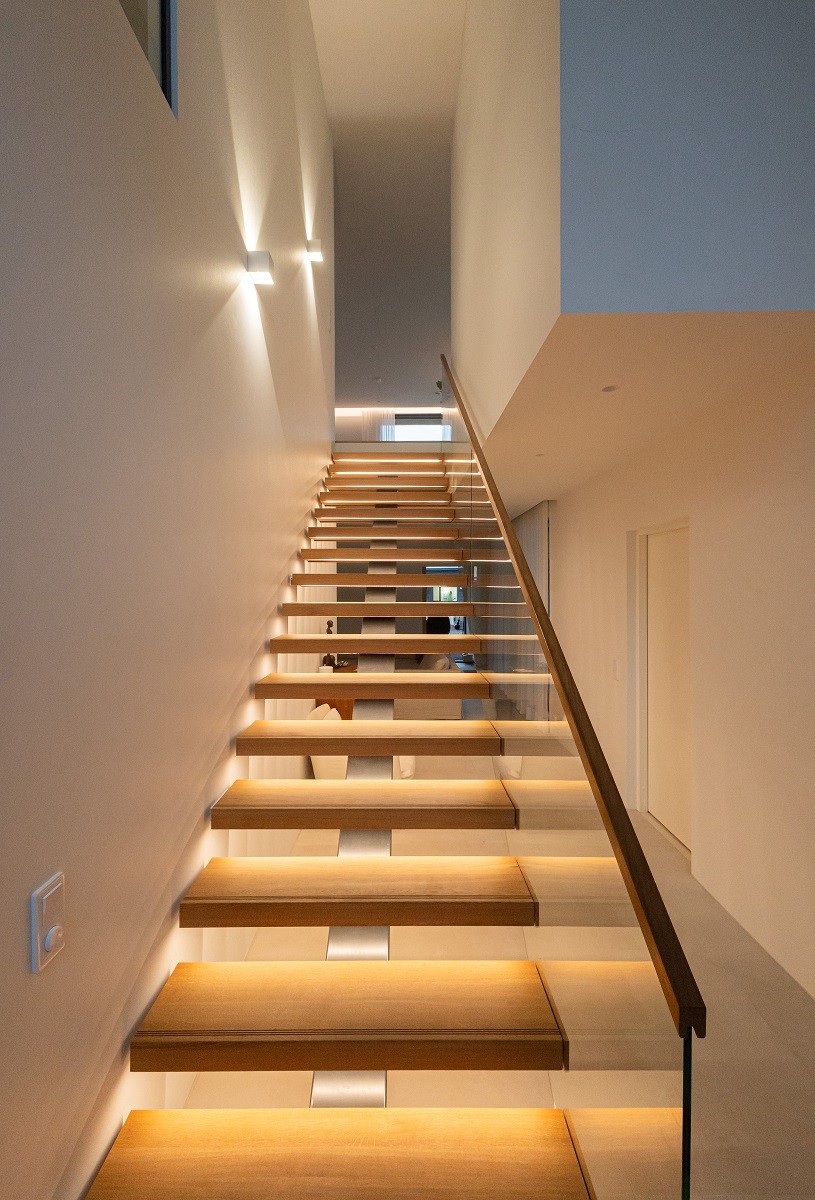
In practice: a straight 14-step timber staircase, steps 90 cm wide
14 × 0.9 m = 12.6 m of strip, but the profile is stopped 5 cm short of the sides. 14 × 0.8 = 11.2 m. COB 7.2 W/m = 81 W, so a 100 W Zigbee driver under the stairs. Cables from the back edge of the steps behind the stringer in a cable duct.
DALI or Zigbee motion sensor at the top and bottom: 10 % at night, movement raises it to 100 %. Materials: 14 profiles of 80 cm at €12 = €170, 11 m of strip €160, driver €90, sensors €100. About €500, work 1-2 days.
2. Wall line following the stairs – the simplest
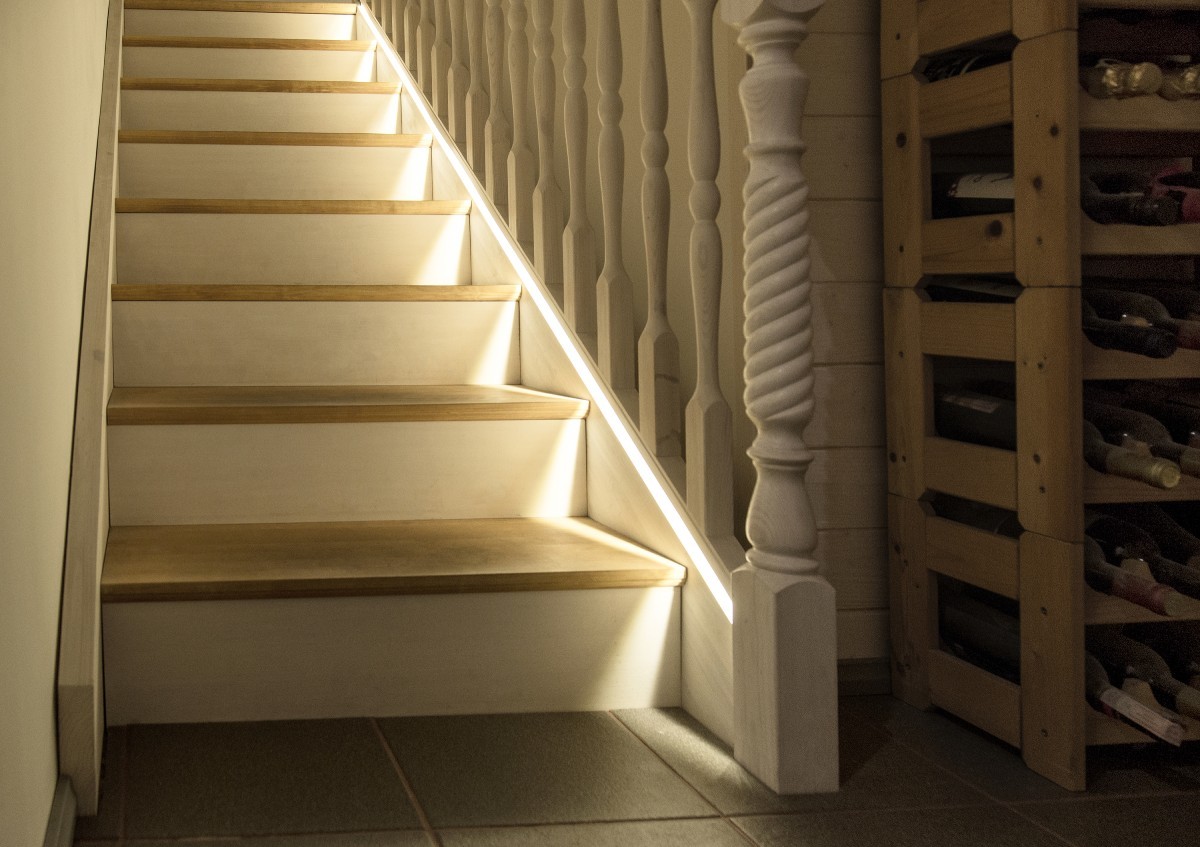
One profile on the wall next to the staircase, 30-40 cm above the steps, sloping with the rise of the stairs. Light down onto the steps and up onto the wall. One strip, one driver, one installation. Not as dramatic as step-by-step lighting, but it lights evenly and can be retrofitted to an existing staircase. A two-directional wall profile sends light both ways.
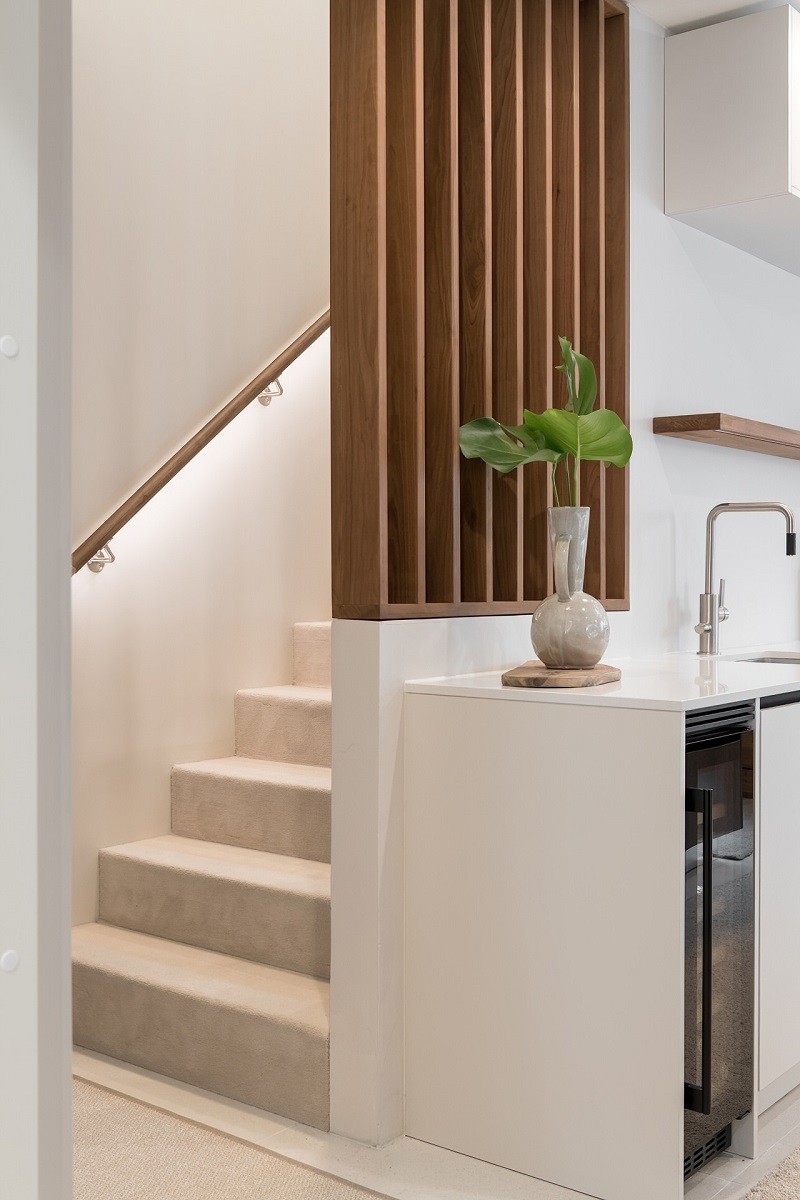
3. Under the handrail
Strip on the underside of the handrail, light down onto the steps. Invisible from above, it lights the walking line. Needs a handrail with a groove for the profile or wide enough for it – at least 40 mm. Works in new builds when the handrail is chosen for the light.
Comparison
| Under the steps | Wall line | Handrail | |
|---|---|---|---|
| Uniformity | Best – every step the same | Good | Good along the walking line |
| Amount of work | 14 profiles, cables to the steps | 1 profile on the wall | 1 profile in the handrail |
| Retrofit | Difficult – cables | Easy | Only if the handrail suits |
| Cost for 14 steps | +1000 € | 250-350 € | 300-400 € |
| Impact | Greatest | Understated | Invisible |
| Suits | New build, solid steps | Retrofit, all staircases | New build, wide handrail |
Sizing
| Amount of light | 100-150 lx on the step, evenly – no more than 3:1 difference between top and bottom |
| Strip power | 7.2 W/m – too much light on a staircase dazzles people coming down |
| Strip type | COB – under the step the strip is 20 cm from the eye and dots would show |
| Colour temperature | 2700-3000 K, the same as the adjacent rooms |
| IP rating | IP20 indoors, IP65 if the staircase is in a basement, outdoors or a boot room |
| Control | Motion sensor at the top and bottom, base level 10 % at night |
| Driver | Under the stairs or in a cupboard, not inside a step |
A night light is safety, not mood
A staircase light completely off at night is a fall risk – when you wake up you do not remember to switch it on. A base level of 10 % always burns in the dark, and a motion sensor raises it when you step onto the stairs. A Zigbee sensor is battery-powered and needs no wiring.
Stairwell – apartment block requirements → · Wall mounting → · Glare shield →
Staircase light → LedStore
Frequently asked questions
How is indirect lighting done on a staircase?
Three ways: a profile under the step front edge with light onto the next step, a wall line following the stairs, or under the handrail. Under the steps is the most striking, the wall line the easiest retrofit.
Is staircase lighting mandatory?
Building regulations require adequate lighting on a staircase. Indirect light under the steps meets the requirement and is safer than a ceiling light that leaves the bottom steps in shadow.
How much light for a staircase?
100-150 lx on the step. Uniformity matters more than quantity – less than a 3:1 difference between the top and bottom step. Varying light makes edges unclear.
Is it worth giving every step its own strip?
It gives the most striking result but is the most work. A wall line lights just as evenly with one profile and works on an existing staircase. Step-by-step lighting is worth it in a new build.
Which strip for staircase lighting?
COB 7.2 W/m – under the step the strip is close and dots would show, and too much light dazzles people coming down. IP65 for basements and outdoors.
How is staircase lighting controlled?
A motion sensor at the top and bottom, with a 10 % base level always on at night. A Zigbee sensor needs no wiring. A staircase completely dark at night is a fall risk.
Profiilit tähän rakenteeseen
Profiilit portaisiin
Askelmaan, listaan tai jalkalistaan asennettavat profiilit. Valo alas kulkuväylälle – turvallisuutta ilman häikäisyä.
Profile-floor-molding-3m
profile-shelf-EDGE-W-3m
Profile-indirect-molding-stairs-3m
Profile-stair-step-3m
Hinnat sisältävät ALV 25,5 % ja ovat LedStore.fi:n voimassa olevia hintoja. Profiilit sisältävät opaalikannen ja päätypalat; LED-nauha tilataan erikseen.
Toteutettuja kohteita
Epäsuora valo portaissa
Käsijohteen alapinta, askelmien reunat ja sivuseinän valolinja – turvallisuusvaloa joka näyttää hyvältä.
Kuvat: LedStore.fi toteutetuista kohteista.